JOLT presale and dates
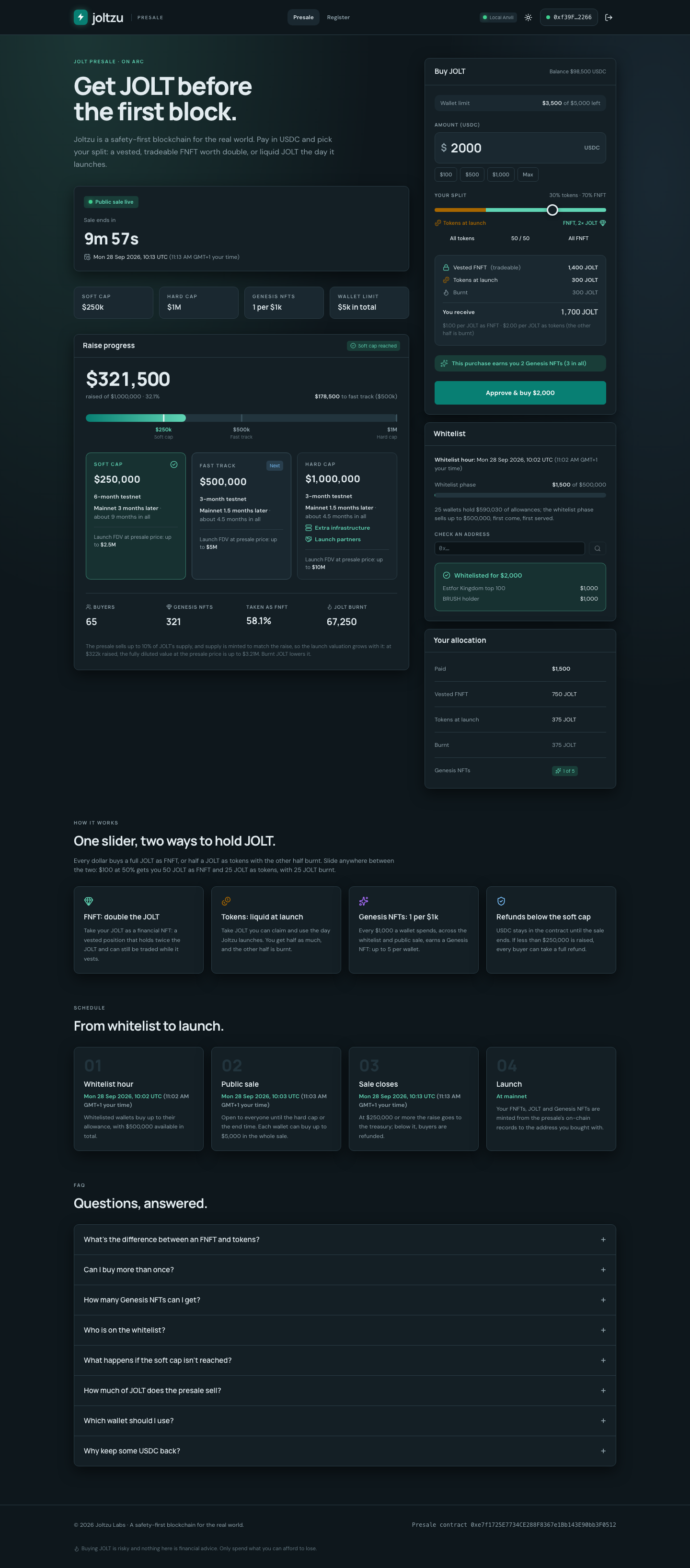
The presale is a USDC sale on Arc, ahead of Joltzu launch. Purchases record launch allocations; they do not immediately deliver native JOLT. Public sale availability and contract addresses remain unconfirmed.
Schedule
The sale start date will be announced. An earlier planning example of 21 October 2026 was never confirmed as an on-chain schedule, and no sale has opened. Treat any date that does not come with a verified contract address as unconfirmed.
| Phase | Time | Basis |
|---|---|---|
| Whitelist opens | Announced start | Set in the deployed contract |
| Public phase opens | Start + 1 hour | One-hour default whitelist phase |
| Scheduled close | Start + 3 days 1 hour | Three-day default public phase |
| Earlier close | When hard cap is reached | Contract rule |
| Native JOLT / FNFT distribution | Joltzu launch; date unconfirmed | Launch integration remains separate |
The durations above are deployment defaults. A deployed contract's whitelistStart, publicStart and end take precedence, and the frontend uses those on-chain times once configured. The schedule cannot be moved once the whitelist phase starts.
Planned offering terms
| Term | Intended deployment setting |
|---|---|
| Payment asset | USDC on the configured Arc network |
| Soft cap | $250,000; below it after close, buyers can claim refunds |
| Hard cap | $1,000,000; reaching it ends the sale |
| Wallet cap | $5,000 across whitelist and public purchases combined |
| Whitelist phase | One hour, $500,000 aggregate cap, individual Merkle allowances |
| FNFT option | 1 JOLT of vested allocation per USDC |
| Liquid option | 0.5 JOLT at launch per USDC; another 0.5 recorded as burned |
| Genesis NFT | One per $1,000 cumulative wallet spend; maximum five at the stated wallet cap |
For $100 entirely in FNFTs, the recorded allocation is 100 JOLT. Entirely liquid, it is 50 JOLT plus 50 burned. At a 50/50 payment split, it is 50 JOLT in FNFTs plus 25 liquid and 25 burned. The final FNFT vesting/transfer rights need launch terms; the sale contract alone does not implement them.
Buyer protections in the sale contract
The sale contract limits what its owner can do with buyers' USDC:
- USDC stays in the contract until settlement. Below the soft cap, or after a permitted owner cancellation, each buyer can reclaim the full amount paid.
- Anyone can trigger a refund, but the USDC always goes to the buyer. A refund invalidates that buyer's launch allocation and Genesis NFT records.
- Pausing stops purchases only. Refunds and withdrawal keep working while the sale is paused.
- The owner can cancel only before withdrawal, and can recover only USDC beyond what buyers could still reclaim.
- Ownership transfers in two steps and cannot be renounced, so the sale cannot be left without an accountable owner.
- The whitelist root can be replaced only before the public phase.
After a successful end, treasury withdrawal enables the post-sale curves to open. Publish the configured owner, treasury, parameters and verified bytecode with the deployment. No audit of the sale contract is claimed here.
The site's cap defaults describe the intended offering. The Solidity contract accepts deployment parameters, so readers should check settings() and saleState() on the actual contract rather than assume every deployment uses these values.
Raise-linked roadmap targets
The proposed roadmap targets a six-month testnet with mainnet three months later at $250,000, and a three-month testnet with mainnet 1.5 months later at $500,000 or $1 million. The higher cap adds infrastructure and partner work. These are development targets, not committed launch dates or promises of performance.
Read participation, bonding curves and tokenomics.