Post-sale bonding curves
After a successful sale, curve trading uses two JoltzuCurve contracts and /trade pages: one for liquid launch tokens, one for FNFT allocations. These use a deterministic pricing formula. The native orderbook is a separate market that matches participant orders.
| Curve | Opening price | Allocation |
|---|---|---|
| Liquid tokens | $2 per JOLT | 2.5% of modeled pre-burn supply |
| FNFT | $1 per JOLT | 2.5% of modeled pre-burn supply |
Anyone can open a configured curve after the presale raise has been withdrawn and any configured curve start has passed. It locks its supply calculation to the final raise. A $1 million raise gives 250,000 JOLT per curve; $250,000 gives 62,500.
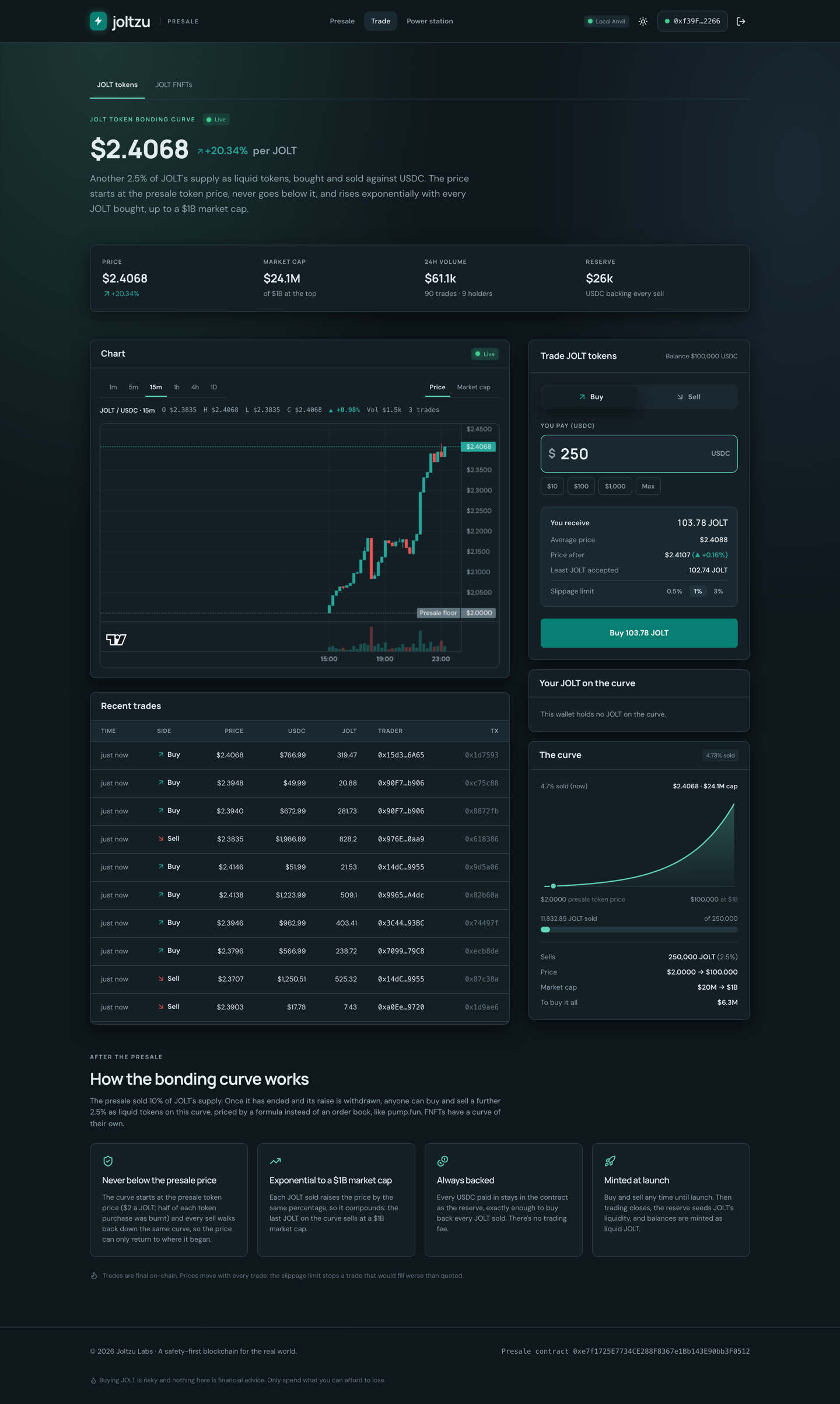
Price and reserve mechanics
Price increases exponentially with net units sold and follows the same curve down on sellback. It does not go below the curve's starting price. The ending price is calibrated to a $1 billion modeled market-cap endpoint; this is a formula parameter, not a forecast, achieved valuation or guaranteed external resale price.
USDC paid on buys remains in the open curve's reserve for sellbacks. The code uses a $1 minimum trade and no curve trading fee; network gas still applies. Trades have explicit minimum output/slippage constraints, and prices can change before inclusion. A presale allocation is not automatically a curve balance available to sell.
Closing and launch
The owner can close a curve at launch. Its reserve then moves to the configured treasury and sellback ends. Net holdings are recorded for launch minting as the curve's product. The curve does not issue native JOLT, FNFTs or a bridge asset immediately. “Backed” here describes the open curve's own contract reserve and sellback formula, not a permanent redemption right after closing or a market-wide price floor.