Joltzu browser extension
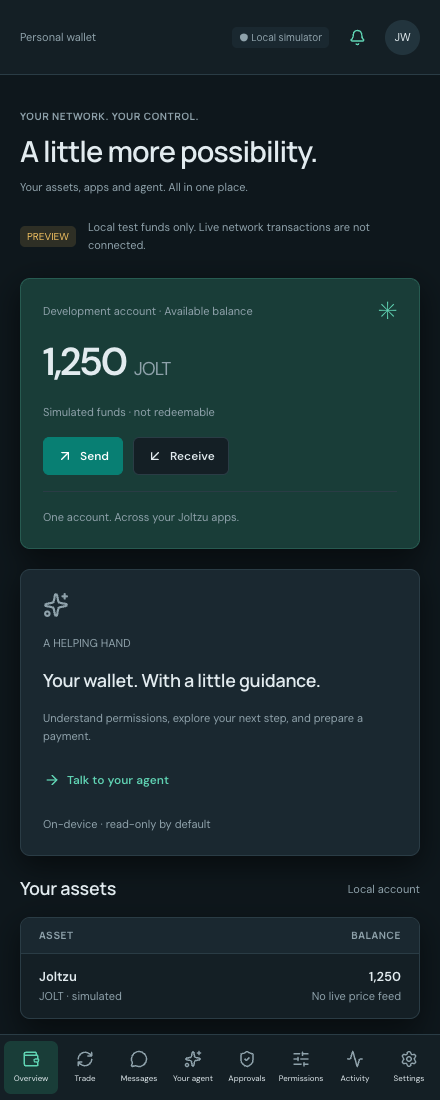
Joltzu Wallet is a Manifest V3 browser extension with a side panel, shared account logic and a website SDK. It has passkey ceremonies, inline approvals, bounded simulator grants, activity, messages and a local assistant. The current build is a development wallet with valueless test funds; live network signing and trading are integration work.
Release availability
The store listing, public download and release date are TBD. Installation instructions will accompany the announced release. The screenshots preview the development wallet and its simulator; they do not establish public availability.
First steps
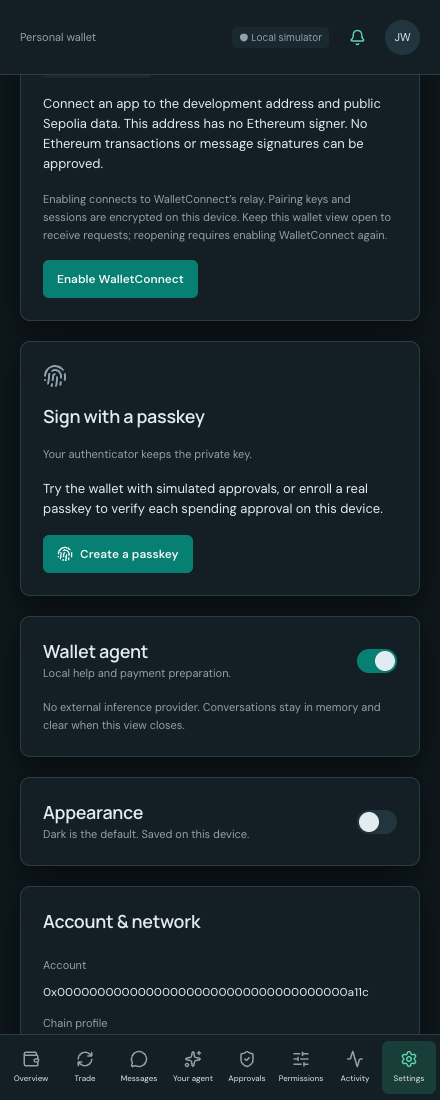
Open Settings → Create a passkey to enroll an authenticator. A real ES256 passkey creation/assertion is verified against a request-bound challenge; the private key stays with the authenticator. Before enrollment, Simulate approval is a local testing option. Neither ceremony currently signs a native Joltzu transaction.
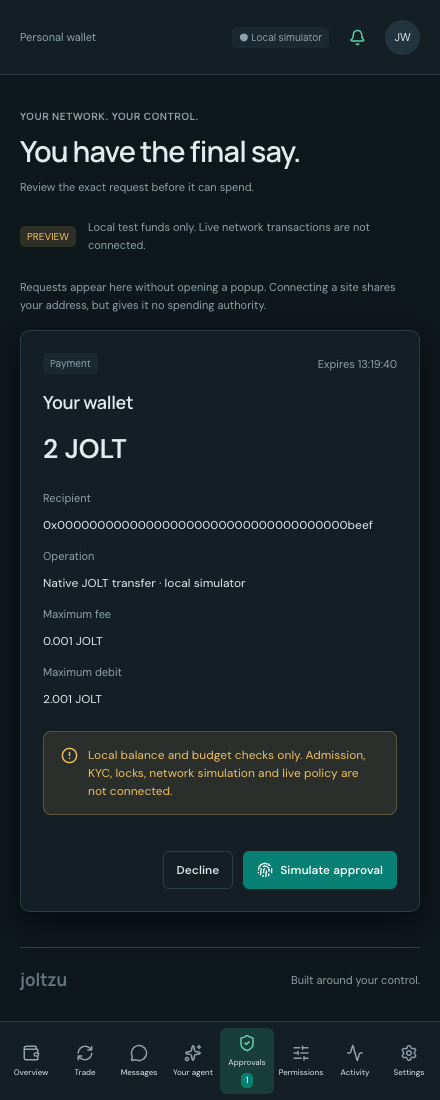
Use Send to prepare a simulator payment and Approvals to review it. Website connections, help and warnings appear inline; spending outside an approved grant requires review. Authenticator verification still opens the platform's own required passkey confirmation.
Screens and capabilities
| Screen | Current behavior |
|---|---|
| Overview / Activity | Persistent simulator balance and local receipts |
| Approvals / Permissions | Review requests; inspect and revoke site grants |
| Trade | Native orderbook / farming route design; execution remains unavailable |
| Your agent | Local rule-based help and payment preparation; no remote inference |
| Messages | Separate prototype encrypted contact messaging and safety codes |
| Settings | Passkeys, theme, preferences, local revocation, native-node reads and watch-only WalletConnect |
Messages use an identity separate from wallet signing and do not grant spending authority. The current envelope/storage design is a prototype; production ratcheting, recovery and multi-device linking remain pending. The assistant does not receive private messages.
Native-node reads
Settings accepts a primary endpoint and up to three backups. Each must be a loopback address with an explicit port; reach a remote node through a tunnel. The wallet tries them in order and uses an endpoint only after it reports the expected chain ID, so no address is sent to a node on the wrong chain. A phone's loopback address refers to that phone.
Reads cover an existing address's balance, nonce and recent native transfers. History is a bounded scan of recent blocks, so an empty page does not prove that an address never received JOLT. These reads never alter simulator balances or prove ownership.
What the extension can access
The extension asks for as little browser access as it needs:
- Permissions: browser storage and the side panel only.
- Network: its pages load no remote scripts. Connections are limited to the local loopback address, one public Sepolia RPC and the WalletConnect relay.
- Websites: its page scripts run on HTTPS and local pages so sites can discover the wallet. A site still sees no account until you approve a connection, and websites cannot call the wallet's node methods.
- Windows: it opens no popups or windows on its own. Approvals appear inline in the side panel.
Compatibility and limits
The extension supports EIP-6963 discovery, connection permissions and read-only Sepolia Ethereum calls. Its Ethereum address is watch-only; transaction and message signing are unsupported. WalletConnect sessions negotiate that same read-only profile and require separate inline approval. Connecting does not authorize an Arc presale purchase.
The simulator uses six decimal test units. Native JOLT's node denomination is 18 decimals. Never translate simulator amounts, passkey assertions or sim: receipts into real Ethereum/Joltzu transactions.
Account recovery, network-enforced grants, mobile enrollment, identity/KYC and live swaps need separate integrations. There is no seed phrase to export in the current model. The extension and Capacitor app share React DOM screens; the Expo app remains the mobile implementation until Capacitor's iPhone and Android device checks pass.
Read permissions, website integration and orderbook behavior.